

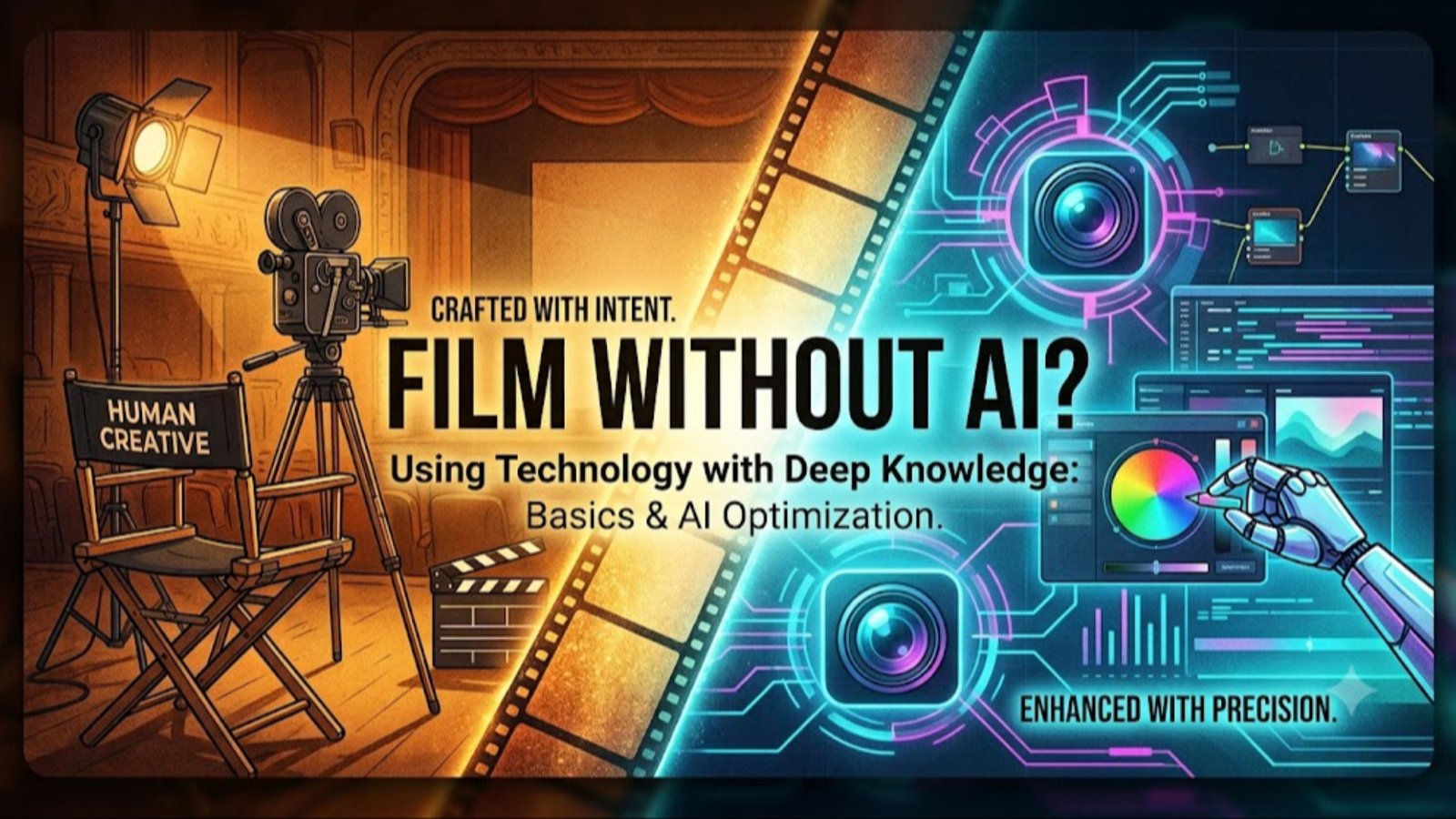
Film Without AI?
Basics of Filmmaking
In an era dominated by text-to-video prompts, hyper automated color grades, and algorithmic script doctoring, a quiet debate is sweeping through the filmmaking community.
Every few weeks, a shiny new tool promises to trim days off post production or turn a single sentence into a photorealistic sequence. It’s easy to look at this wave and wonder: Should we hand the keys entirely over to AI, or should we reject it completely?
The real answer lies somewhere in between: Don't entirely rely on AI—use it with deliberate knowledge.
AI is a multiplier, not a composer. A multiplier applied to zero is still zero. To harness technology without losing your artistic voice, you need two distinct forms of knowledge working in tandem: the fundamental basics of filmmaking and a strategic understanding of where AI excels.
1. Knowledge of the Basics: The Unshakeable Foundation
AI can generate pixels, but it cannot generate artistic intent. When you understand the core mechanics of cinema, you use technology to execute a vision—rather than letting an algorithm dictate one to you.
┌──────────────────────────────────────────────────────────┐
│                   THE THREE-POINT LIGHT                  │
│                                                          │
│     [ Key Light ]                  [ Fill Light ]        │
│    (Primary Source)               (Softens Shadows)      │
│            \                             /               │
│             \                           /                │
│              \       [ Subject ]       /                 │
│                          |                               │
│                          |                               │
│                   [ Back Light ]                         │
│                 (Separates Background)                   │
└──────────────────────────────────────────────────────────┘
The Script: Emotional Intent Over Structural Tropes
AI can output a standard three-act structure instantly, but it lacks lived experience—the awkward pause in a conversation, the subtext of a shared glance, or personal grief.
Motivation: What does your protagonist want, and what will they sacrifice for it?
Subtext: What are they actually feeling while saying something else?
Cinematography: Light, Glass, and Space
Generative engines create imagery by predicting pixel combinations. Real cinematography is an act of real-world physical choice.
Framing & Composition: Placing a subject on the left third of a frame with negative space conveys isolation intentionally.
Lighting: A single hard light source creates tension that no digital filter can replicate unless you understand real physical space.
Lens Selection: Choosing a 35mm lens over an 85mm changes how intimate or distant the scene feels to the viewer.
Directing and Editing: Pacing and Performance
You cannot prompt a human being into a genuine, nuanced performance, nor can an algorithm know precisely when an emotional beat lands in the edit. Pacing, match cuts, and J/L-cuts require human empathy to calibrate correctly.
2. Strategic Knowledge: Leveraging AI Where It Excels Best
Once your foundational knowledge is solid, AI stops being a crutch and becomes a powerful technical assistant. The key is knowing where to apply it to gain a competitive edge without compromising your artistic integrity.
| Filmmaking Stage | Where AI Excels Best | What Remains Uniquely Human |
| Pre-Production | Concept art generation, location/set visualization, pitch deck layouts | Crafting the core narrative, character depth, thematic vision |
| Production | Automated script logging, shot-list organization, voice/tone matching | Directing actors, real-time lighting adjustments, camera movement |
| Post-Production | Noise reduction, rotoscoping, automated dialog sync, fast assembly cuts | Pacing, sound design dynamics, emotional story structure |
| Distribution | Captions, localization, platform aspect-ratio reframing | Marketing strategy, audience connection, authentic narrative pitch |
How to Blend Both:
Pre-visualize Fast: Use generative AI to turn your hand-written director's notes into quick mood boards or storyboards to communicate your vision to your crew.
Offload the Tedium: Let AI handle time-consuming technical tasks like background rotoscoping, clean-ups, or transcribing audio so you spend more energy on cutting for emotion.
Enhance, Don't Replace: Use AI tools to retouch or polish a scene, but ensure the core lighting, performance, and camera moves were driven by your foundational expertise.
The Hybrid Mindset
A tool is only as good as the hand guiding it. If you blindly rely on AI, your work will end up looking like everyone else’s—slick, competent, and completely uninspired.
When you pair deep knowledge of cinema's fundamentals with a sharp understanding of modern tools, you gain the ultimate advantage: the efficiency of technology guided by the heart of a storyteller.